Why We Stopped Syncing Our Bank Accounts (And Started Talking About Money Instead)
By Hearth Team · March 5, 2026
We used to be obsessed with automation.
Our financial life was a web of API connections. Mint, YNAB, Personal Capital — you name it, we had linked our accounts to all of it. We wanted a "dashboard for our life" where we could see every penny without lifting a finger.
It felt like the future. It felt efficient.
But after years of automated tracking, we realized two uncomfortable truths:
- We were still overspending.
- We were spending more time fixing broken bank connections than actually talking about money.
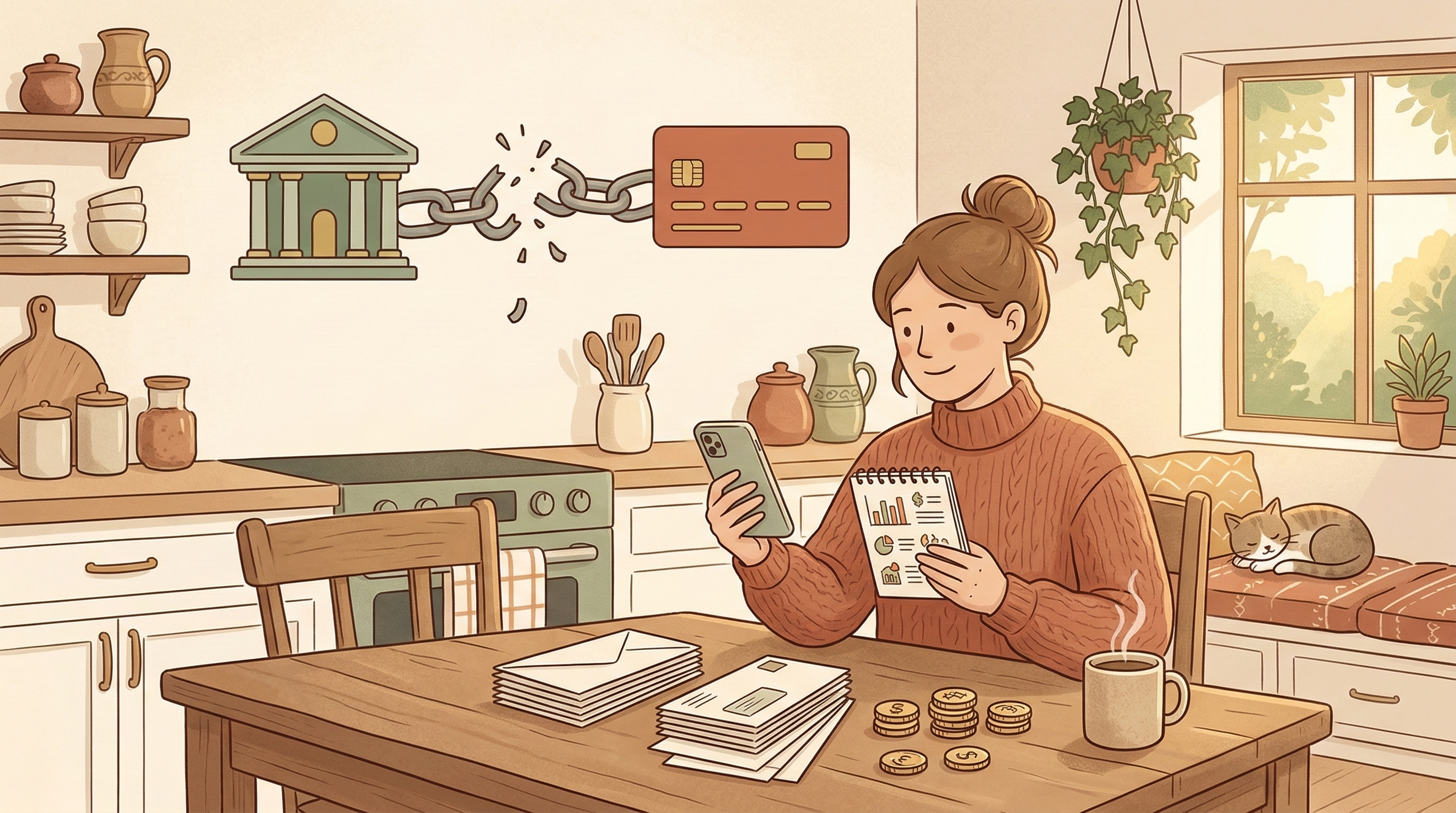
So we did something radical. We disconnected everything. We went back to manual entry.
And for the first time — together — we actually started saving.
Here's why automated bank linking is failing you and your partner, and why manual entry is the secret weapon you didn't know you needed.
The "Autopilot Problem"
Automated tracking promises to save you time, but it costs you awareness.
When transactions import automatically, you review them after the damage is done. It's like counting calories at the end of the week. You can see exactly why you gained weight, but the data is too late to change the outcome.
Automation turns you into a spectator of your own financial life. You watch the numbers go down, shrug, and hope next month is better. Hope is not a strategy.
Manual entry forces you to be the pilot. When you enter a transaction, you're confronting your spending in real-time. That split-second of awareness is often enough to stop a bad decision before it happens.
The "Pain of Paying"
Behavioral economists talk about the "pain of paying" — the negative feeling you get when you part with money. Credit cards and one-click checkouts are designed to numb this pain. They make spending feel like nothing.
Automated budgeting apps extend this numbness. You swipe your card, and nothing happens. Maybe you get a notification three days later.
Manual entry reintroduces a healthy dose of friction.
When you have to physically open an app and type "$50.00 — Dinner," you feel it. You acknowledge the trade-off. That tiny pause creates mindfulness. It makes you ask, "Was this worth it?"
Privacy, Security, and The Connection Nightmare
Let's be honest: bank syncing sucks.
It breaks constantly. You log in to check your budget, only to find a "Re-enter Credentials" error. Two-factor authentication updates break the link. Plaid fights with your bank. You spend 20 minutes debugging a connection just to see how much you spent on coffee.
And then there's the privacy aspect.
To use these "free" apps, you're often handing over the keys to your financial kingdom — sharing login credentials and transaction history with third-party aggregators who may sell your data or use it to target you with ads for credit cards you don't need.
Manual entry never breaks. It never asks for your bank password. It's 100% private, 100% secure, and 100% reliable.
From Passive Observer to Active Participant
Linking your accounts is a passive activity. You set it and forget it — and eventually, you forget to budget altogether.
Manual entry is an active ritual. It takes less than 2 minutes a day (seriously, we timed it), but those 2 minutes change your identity. You stop being someone who "has a budget" and start being someone who budgets.
You become an active participant in your financial success.
What Happens When Two People Stop Hiding Behind Automation
Here's the part nobody talks about: automated budgeting doesn't just make you passive — it makes you passive together.
When both partners can see a dashboard updating in real-time, there's no reason to talk. You just... watch. The grocery number creeps up. The dining-out envelope turns red. Nobody says anything because there's nothing to decide — it already happened.
The dashboard becomes a shared wall of silence.
When you switch to manual entry, something shifts. One of you logs the grocery run. The other notices the category is getting tight. Suddenly, you're actually talking — not about the past ("you spent $80 on takeout again?") but about the present: "Should we move some money from entertainment to groceries this week?"
That's a completely different conversation. It's collaborative, not accusatory. Forward-looking, not a post-mortem.
Manual entry forces the money conversation that most couples are quietly avoiding. And having that conversation regularly — even for two minutes while someone logs a transaction — is what turns a budget from a source of tension into a shared project.
You stop being two people watching the same screen and start being two people building something together.
Try It for a Month
If your fancy automated dashboard hasn't made you rich (or gotten you on the same page) yet, maybe it's time to try the "hard" way.
Disconnect your accounts. Commit to entering your expenses manually for just one month — together. See if the "pain of paying" helps you keep more of your hard-earned money, and whether talking about it changes things more than the numbers ever did.
Ready to budget as a team?
Hearth Budget is built for couples who want to manage money together — without the drama of broken bank links or shared spreadsheets. Manual entry first. Partner sharing built in. One shared budget, two people actually in it.